
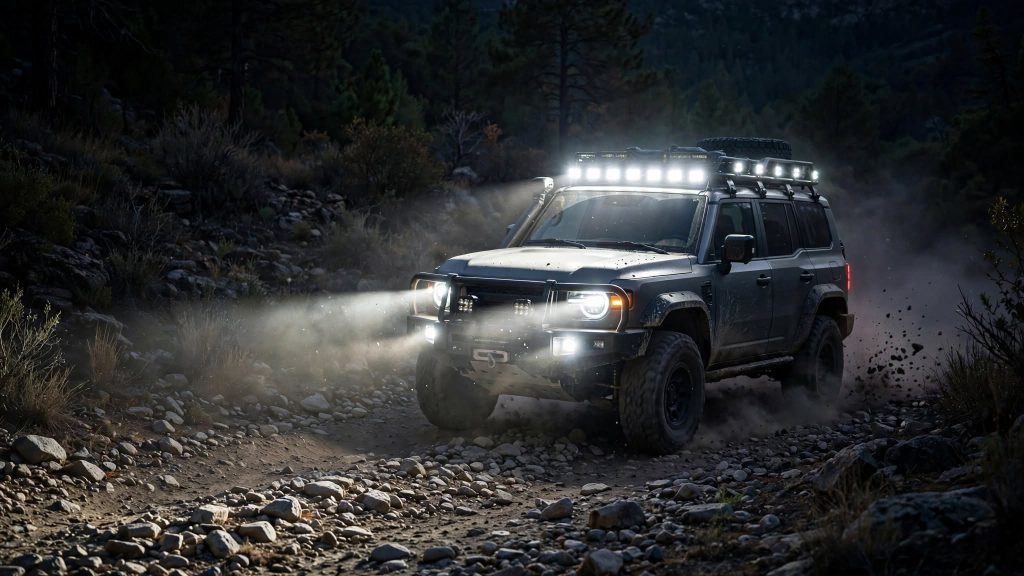
Driving off-road after dark creates a very different visibility challenge from ordinary nighttime driving. Trails may have no street lighting, surfaces can change without warning, and obstacles such as rocks, branches, ruts, dips, and uneven ground can be difficult to identify with standard vehicle headlights alone.
LED light bars help address these conditions by providing additional illumination around and ahead of the vehicle. When properly selected, positioned, and aimed, they can give drivers a clearer view of the trail and more time to recognize changing terrain.
Why Standard Headlights Can Be Limiting Off-Road
Factory headlights are primarily designed for normal road use. Their beam patterns are intended to illuminate the roadway while controlling glare for other drivers. That makes sense on public roads, but off-road environments can require a wider or differently shaped field of light.
On a narrow trail, for example, a driver may need to see both the path ahead and the edges of the track. When navigating rough terrain, seeing the surface immediately in front of the vehicle can also be important for identifying holes, rocks, and sudden changes in elevation.
An LED light bar supplements the vehicle’s existing lighting rather than replacing it. Different beam patterns can provide additional distance, width, or a combination of both.
How LED Light Bars Expand the Driver’s View
Wider Illumination Around the Trail
One of the main advantages of LED light bars for off-road driving is their ability to spread light across a broad area. A wider beam can illuminate trail edges that may receive limited light from standard headlights.
This can be useful on winding tracks, wooded trails, campsites, and open terrain where hazards are not always directly in front of the vehicle. Better side visibility can also help when approaching turns or maneuvering through confined areas.
Better Visibility of Uneven Terrain
Off-road surfaces are rarely consistent. Loose stones, deep ruts, fallen branches, muddy sections, and changes in ground level can appear suddenly.
Additional lighting makes these surface features easier to identify before the vehicle reaches them. This gives the driver more visual information for choosing a suitable line and adjusting speed according to the terrain.
Mounting position matters here. A very high-mounted light may illuminate farther ahead, while carefully positioned lower auxiliary lights can help reveal texture and shadows closer to the vehicle.
Choosing the Right Beam Pattern
LED light bars are available with different beam patterns, and the appropriate choice depends on how and where the vehicle is used.
A spot beam concentrates illumination farther ahead in a relatively narrow pattern. It can be useful for open trails where seeing into the distance is important. A flood beam spreads light across a wider area, making it more suitable for slower driving, tight trails, work areas, or situations where peripheral visibility matters.
Combination beam light bars bring spot and flood characteristics together. They can provide broader illumination near the vehicle while directing some light farther down the trail.
The goal should be useful light distribution rather than simply choosing the brightest option available.
Installation Has a Major Effect on Visibility
Even a suitable LED light bar can perform poorly if it is mounted or aimed incorrectly. Excessively high or upward-facing light can create glare, illuminate dust or fog, and make it harder to see the trail clearly.
Before installation, it is worth reviewing Essential Vehicle Lighting Accessories for a Reliable Installation because mounting hardware, wiring components, switches, connectors, and related accessories all affect how securely and reliably auxiliary lighting operates.
The light bar should be mounted firmly enough to prevent vibration on rough surfaces. Wiring should also be protected from water, mud, heat, abrasion, and moving components.
Positioning LED Light Bars for Different Uses
There is no single mounting location that works for every off-road vehicle.
Roof-mounted LED light bars can provide broad illumination from a higher position, but their placement may sometimes create reflections from the hood, dust, or nearby surfaces. Bumper-mounted bars generally sit closer to the ground and can provide useful forward lighting without placing equipment above the roofline.
Smaller auxiliary LED lights can also be positioned toward the sides of a vehicle when additional peripheral illumination is needed.
Drivers should consider the vehicle’s shape, typical terrain, beam pattern, and intended use before deciding where to install off-road lighting.
Managing Glare, Dust, and Weather
More light does not automatically mean clearer vision. Bright auxiliary lighting can reflect from airborne dust, rain, fog, snow, or nearby objects.
On dusty trails, intense forward-facing illumination may highlight particles directly in the driver’s field of view. In these conditions, reducing unnecessary light or relying on appropriately positioned lower lighting may improve usable visibility.
The same principle applies when driving through fog or heavy precipitation. Light placement and beam direction can matter as much as output.
Keeping the lens clean is also important. Mud and dust buildup can scatter light and reduce the effectiveness of the beam.
Use Auxiliary Lighting Responsibly
LED light bars intended for off-road use may be subject to restrictions when a vehicle returns to public roads. Requirements vary by location and may address when auxiliary lights can be used, how they must be mounted, or whether certain lights need to remain switched off or covered.
Drivers should check the rules that apply in their area before using off-road lighting on public streets.
It is also important to avoid directing powerful auxiliary lights toward other drivers, trail users, campsites, or nearby properties.
Conclusion
LED light bars can improve off-road visibility by extending illumination beyond the limits of standard headlights. Depending on the beam pattern and mounting position, they can help reveal trail edges, uneven surfaces, obstacles, and terrain farther ahead.
Effective off-road lighting depends on more than output alone. Beam pattern, mounting height, aiming, wiring, weather conditions, and responsible use all influence how useful the additional light will be. Choosing and installing an LED light bar around the conditions the vehicle actually encounters can provide a clearer and more practical view of the trail after dark.